
When competition disappears, prices rise, choices shrink, and patients and employers are left paying the hidden cost of consolidation.
Why Health Care Costs Keep Rising
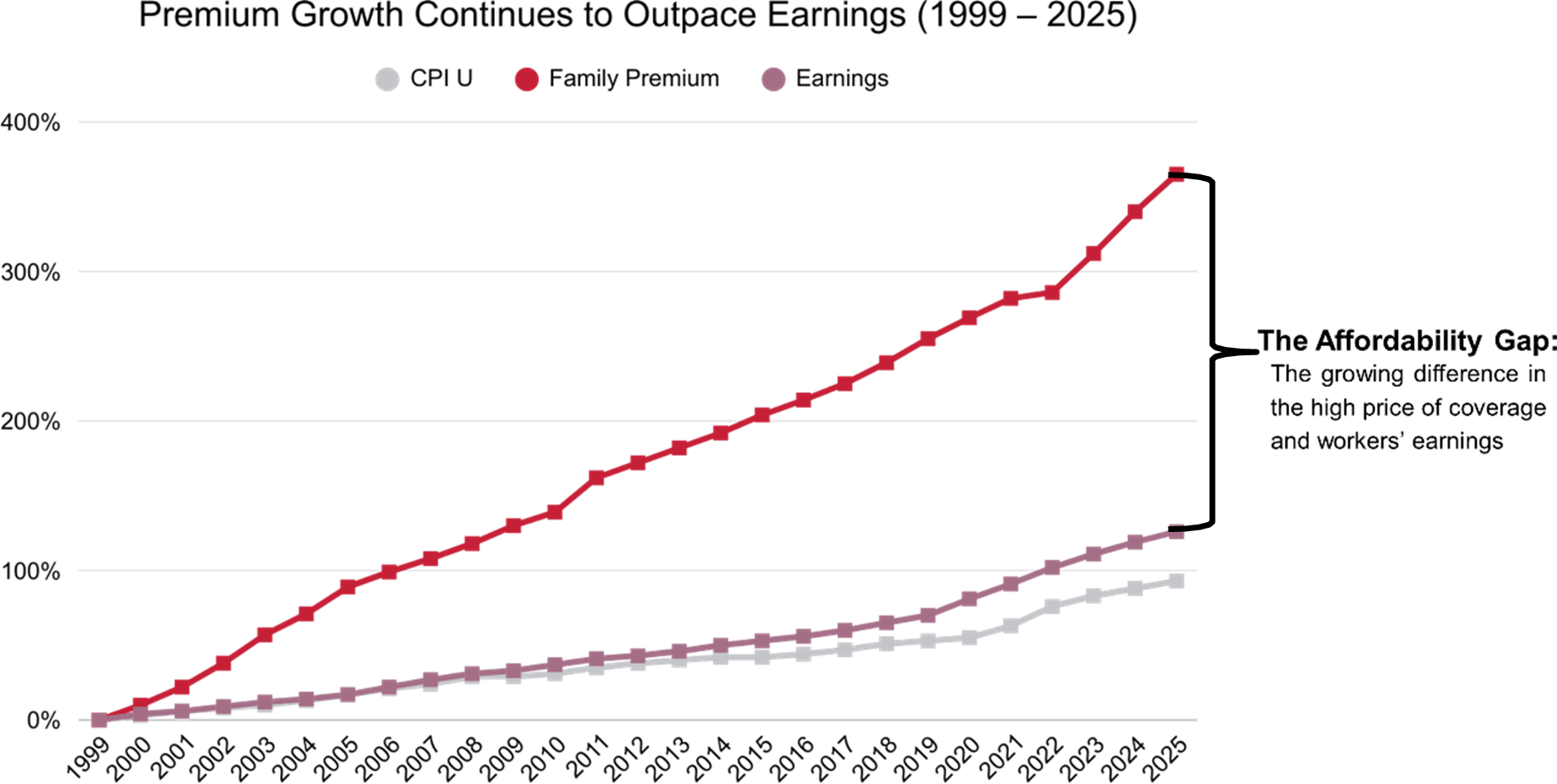
Without reform, the typical American family could spend up to 40% of household income on health insurance premiums by 2032.
The Problem: Too Much Consolidation, Too Little Competition
Health care markets work best when patients and employers have real choices, prices are clear, and providers compete to deliver better care at lower costs.
That is not how the system works today.
Across the country, hospitals have consolidated into massive multi-billion-dollar systems. At the same time, major insurance companies have expanded by acquiring physicians, pharmacy benefit managers, pharmacies, and clinics .
The result is a health care system where patients may appear to have choices, but those choices are often controlled by a few large organizations.
When just a handful of hospitals or insurers dominate a market, employers, businesses, and families have fewer choices and less leverage. When both are concentrated, families get squeezed from both sides.
A Multi-Front Policy Failure
Over the past decade and a half, federal and state laws and regulations have added layers of mandates, reporting rules, compliance systems, benefit requirements, subsidies, and payment structures to an already complex health care system.
These policies were often well-intentioned. But they have frequently rewarded size instead of value.
Large insurers and hospital systems can spread compliance costs across huge revenue bases. Smaller insurers, independent physician practices, and community hospitals often cannot. As a result, smaller competitors face more pressure to sell, merge, or leave the market.
This dynamic encourages consolidation.
When the system becomes more complex, the largest organizations are better positioned to absorb the costs, manage the rules, and use their scale to gain negotiating power. Over time, this weakens competition and gives dominant players more ability to raise prices.
That is how complexity becomes a cost driver.